
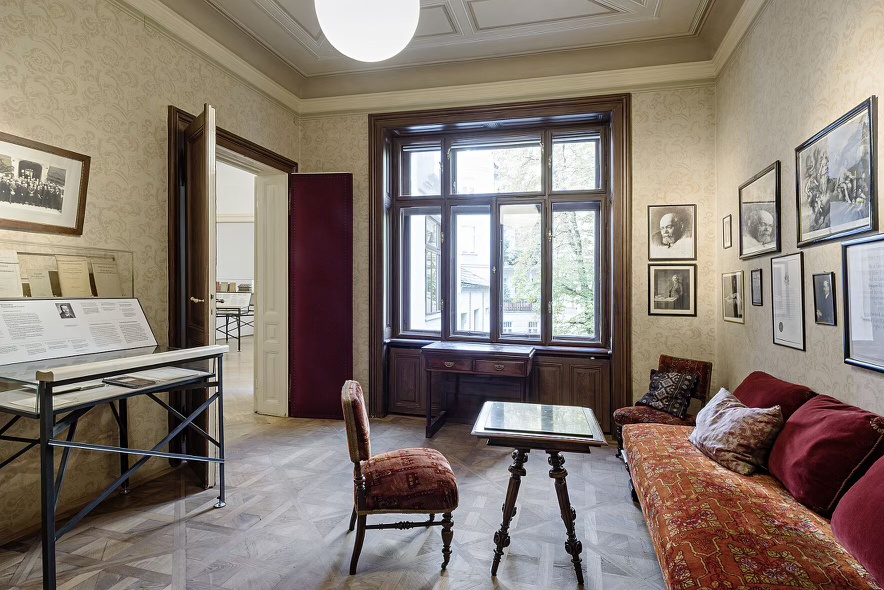
I went to Vienna, and I could not stop thinking about Freud. It felt very important to me to see his home and office. I asked myself “why?” Why are you so drawn to this space, why do you need to stand in it, be in it?
He was the first, I answered. Everything comes from the beginning, and he is the beginning. But as I approached his home, I knew it was something different. I have always had great respect for his work, but it was never the landing place for me. I saw and see his work as the beginning of a conversation, and I consider myself a lifelong student of all the work that has and continues to develop post-Freud.
What is it, I thought, and why did I want to see his home in Vienna and not in London?
As I was in his Austrian home the answers began to unfold in front of me. This is the first wall didactic that I read upon entering his home:
“As a Jew persecuted by Nazi regime, Freud and his closest family fled Vienna in 1938, one year before his death on 23 September 1939. Because of his international fame, he was able to take his belongings, including his psychoanalytic couch, into his London exile. What remained at the origin of psychoanalysis were numerous blank spaces, but also traces from Freud’s lifetime: these “remains of memory”, which have now been exposed, mark the site of his activities as much as they evoke the Shoah, the loss of culture and humanity in the Second World War.”
This is when I understood. I needed to come and bear witness to the “blank spaces”, the spaces that represented not only the beginning of a new “therapeutic method”, but also what was lost. I understood at that moment what an incredible gift it is that amongst this most horrid destruction of life and work, Freud’s work lived on. The conversation has not stopped, and I am privileged to be a part of it.
The museum had one recording of Freud, or at least one that I found. I picked up the headphones to listen to his voice with some trepidation. I was a little nervous. Would I be disappointed by his voice? Would the pain of what was lost become too intense? I picked up the headphones, and what I heard was my grandfather. He sounded so much like my grandpa. My grandpa who always said he was from Austria. A ‘Galitsianer’ he would say. It felt comfortable; I remembered my “remains of memory.”
Freud began speaking in English and as he started to talk about the war, his language transformed into German. He returned to English at the very end of the recording simply to say “I am Sigmund Freud.”
My experience felt complete. I responded to the recording in my head and I said “yes you are, and thank you.”
As I grappled with my emotions about Freud, explored the intense multi-dimensional history of Vienna, the various Jewish sections of the city, and a myriad of castles and art museums, I found Viktor Frankl’s home. Viktor Frankl was an “Austrian psychiatrist, neurologist and founder of the Third Viennese School of Psychotherapy (After Freud and Adler) – Logotherapy and Existential Analysis.”
Whereas Freud’s home was deeply identified with loss and identity, Frankl’s home, in contrast, was teeming with hope. The museum was very small, just 2 or 3 rooms, depending on how you look at it, but his energy transformed the space. You felt his intensity while reading all the material presented. I felt myself pulled into a force that was both magical and grounded. Sometimes you could literally hear his voice in the space, as someone put down the headphones while the recording was still playing. I visited this museum with my daughter, and I noticed that although we began the museum reading each didactic together, at some point we both became so drawn into the material that we almost forgot where we were. We came together at the end and were drawn out of our internal processing by the women who worked in the museum letting us know that they would be closing soon.
Frankl reminded me of the dangers of collective guilt. He, with great vigor and intensity, reminded me that people are individuals and that there are good people in surprising spaces. He reminded me of my individual responsibility and how this responsibility is inextricably linked to freedom. He reminded me of the power of love, the power of hope, and the necessity of meaning making.
As we made our way back to the front door, I stated to the woman at the desk, “you must love working at this museum.” She expressed that she did and that her favorite days are when Frankl’s wife comes by, who still lives in their home next door and is 99.
We walked out of the space and found ourselves in front of a door that we had not noticed on the way in. It merely said “Viktor Frankl.” We paused as if to pay homage, and I said to my daughter, “Can you imagine how wonderful it would have been to live in the same building as the Frankls?”
Leave a Reply