
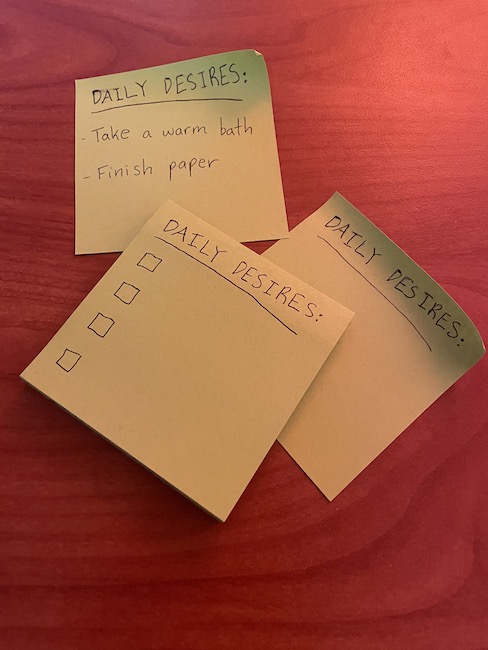
Since I posted my last blog on To-Do lists many people have inquired on how to write a Daily Desire list. The key to a Daily Desire list, and the biggest differentiator between the Daily Desire list and the To-Do list, is the motivation for the list, as well as the relational aspect with self that happens while writing the list.
It can be helpful to look at one’s To-Do lists as first drafts for their Daily Desire lists.
There are 4 steps needed to turn a To-Do list into a Daily Desire list.
Step 1: Ask yourself if all the things you have listed have to happen in one day.
This first step asks one to be introspective about time. How much time do you have in your day to get things done and still take care of your responsibilities? If you are working a full time job, there may not be time to take care of most of the things on your to-do list. To have a list sitting there telling you that you are supposed to be doing things, when you know you do not actually have time for them, is debilitating. One can begin to feel as if they have failed before they have begun. It can also lead to anger and resentment. So many people are working tirelessly to support their families, balancing care of children and work, taking care of parents, trying to get a promotion, managing mental health issues, fighting oppressive systems in the workplace, or working a job that you do not like to pay the bills. There is absolutely no need to come home from all of that to a list telling you that you need to do things you do not have the energy to do. Instead, I encourage you to get a pad of paper out and write Daily Desires on the top of a week’s worth of pages and then pause and realistically look at your time. Move the items from your To-Do list onto different days that you think may actually work for you. Trust yourself and value your time.
Step 2: Ask yourself if you have left room for play, relationships, or rest.
Interestingly enough, this step also relates to time and asks us all to look at what is important in life for sustenance, renewal, healing, growth, and strength. It broadens the concept of responsibilities to include responsibilities to one’s well being. I encourage you to look at your newly made Daily Desire lists for the week and add “activities” that center around play, rest, and relationships. Daily Desires can include things like going out to dinner with a friend, meditating, exercising, golfing, watching TV, breathing, napping, laughing, reading, creating, journaling, stretching, making tea, going to a movie, seeing a show, crying, pausing, singing, dating, Reiki, and daydreaming. A daily list that reminds us to feel, experience, dream, hope, and even to mourn, is a list that is lovely to look at when you get up in the morning. This kind of list has the potential to become the voice of a loving parent, carrying the messages of a secure object, instead of the voice of the punishing parent.
Step 3: Ask yourself, does my list reflect my true desires?
This is an essential step. To help understand this step, I have written a sample To-Do list.
Here is an example of a possible To-Do list:
- Make dinner
- Clean the closets
- Return my package to Amazon
- Help kids with homework
- Write my report
Let’s look at the first item on the list, make dinner. Eating dinner is an important part of every day, but making dinner is not necessarily something that one desires to do. The lack of desire may be a result of disliking cooking; it may be because you do not have the time, or that you want to make sure rest and pleasure are part of your daily desires. No matter the reason, making dinner can easily turn into ordering dinner out, or heating up a pre-made dinner. The same goes for cleaning the closets. After you decide what day works best for you and make sure you have not ignored other desires, you then have to decide if you actually need to be cleaning the closets. The list may need to change to the following: communicate with my family about who is cleaning what closet, hire someone to clean my closets (if able), or clean just one closet. The key to this step is removing the “should of’s, must haves or supposed to’s.” It gives us the opportunity to connect to our agency, to ask ourselves if we desire to do this task in this way, at this time, with these people. It takes away expectations and replaces it with choice. This list becomes a pathway towards freedom, instead of a result of oppression.
Step 4: Understand that these lists are not stagnant.
Check in with your list throughout the day to see if you desire to make any changes.
Desires change daily and therefore so can your Daily Desire lists.
Leave a Reply