
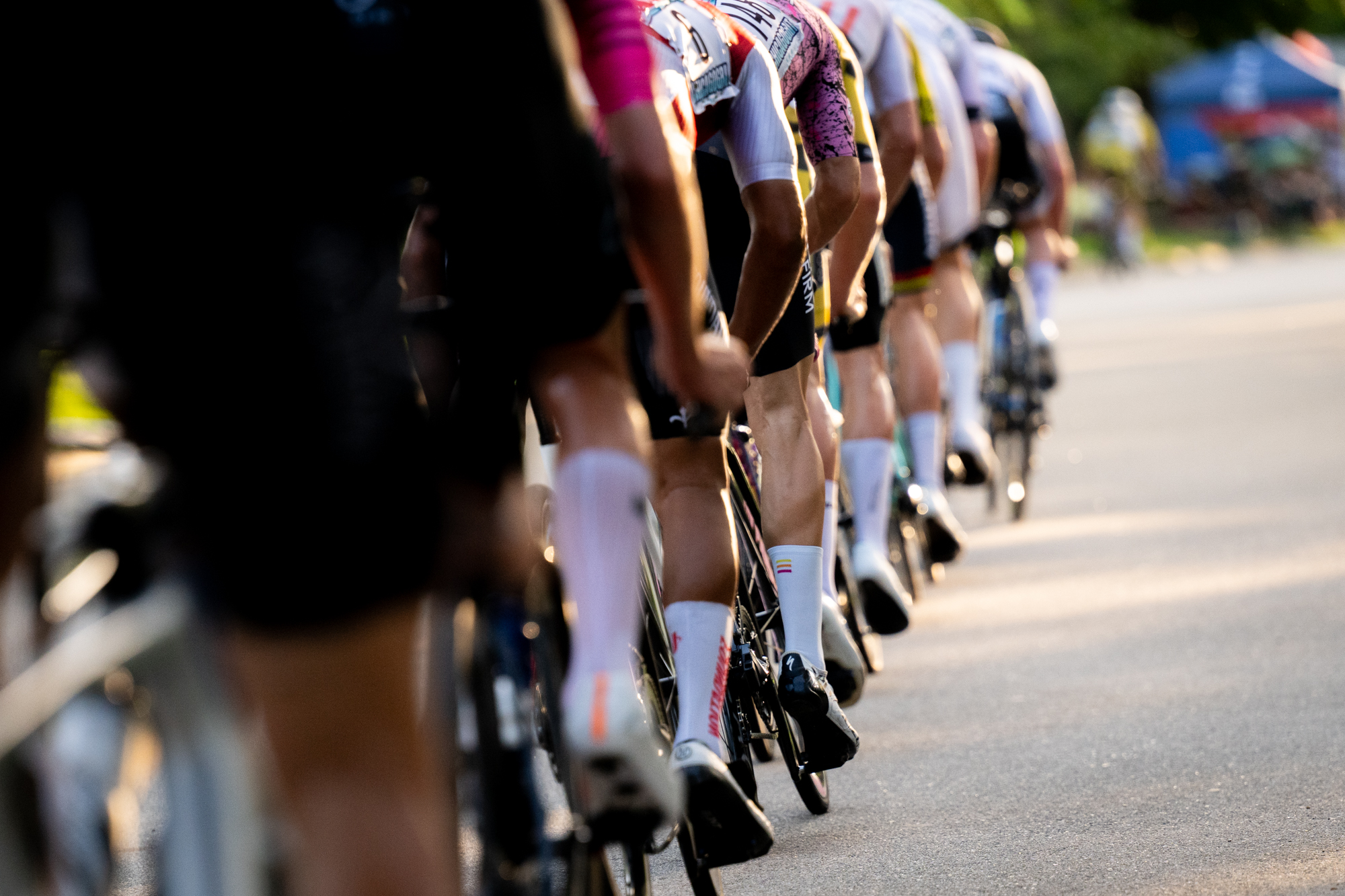
The sun is beating down. It’s 90º. I’m carrying my water bottle and a trekking umbrella for the sun. A collapsible stool hangs over my shoulders, in case I want to sit down. My husband is beside me, usually wearing a matching shirt. We are warm, but still so excited to be there. We are chatting with each other about the heat and whether or not we want to walk or stay still and then we hear the sound of the lead car. We turn with anticipation, ready to spot our son as the peloton zooms by at 30 maybe 40 miles per hour. If I do not spot him, I turn to my husband and make sure he does. If neither of us do, we wait for what feels like an eternity until the peloton zooms by again. The relief that passes between us when we spot him again is both silent and palatable. As we scream his name, we are wanting him to know that we are here for him, and that he can do it. After about 5 or 6 laps, our minds then shift rapidly to how he is racing. We wonder about his strategy, how he feels physically, and how he feels emotionally. We wonder if the stressors of the world are impacting his ability to perform at the level he desires.
As I stand there, with awe and respect, watching him race for 60 heart stopping moments, I think of how much can be learned from cycling and how therapy can help cyclists and other athletes get the support they so deeply need and deserve.
Presence
The amount of presence necessary to race one’s bike is immense. Can you imagine going 30 miles per hour with another cyclist literally so close to you that they could and, sometimes actually do, touch each other’s bikes and bodies. Can you imagine going that fast and, instead of being present, thinking “I forgot to wash my shirt for work tomorrow?” If you did that you would actually put your life and the lives of others in jeopardy, so cyclists and other athletes have learned to be present. All that is in the mind of the cyclist is the race, the strategy, and their body.
To watch this presence is a gift.
Mobilization Without Activating Fight or Flight.
Racing can definitely activate the nervous system. Your body can read the race as a threat. The whistle blows and immediately someone is chasing you and you do not want them to catch you and/or you are chasing someone else and want to catch them. In the process of this chase a water bottle can appear in the road, someone can go off of their line and veer in front of you, or there may be a crash that happens in your pathway and you have to navigate to safety. How can one’s nervous system not react to this as a threat? One could think that staying in this place of fight and flight is good for a race. Won’t it make a cyclist go faster? In actuality it has been shown that “while this response can initially be beneficial in a race environment, it’s not a sustainable state, especially in an endurance event. Worse, the resulting parasympathetic reaction can slow you down, ultimately taxing your system more as you try to keep racing.” Watching these cyclists navigate the course, the other riders, and their own bodies to be able to find an internal flow state that is able to handle any obstacle is thrilling to behold.
Resilience and Determination
They say the best way to deal with a fall is to get back on the horse and, in the case of cycling, get back on the bike. More specifically, they mean get back on the bike seconds after you have just crashed out, your kit is torn and you are bleeding. They mean stay on the bike in 90º weather. They mean keep pedaling when your vision is blurred, and the burning sensation in your legs becomes all consuming. They mean keep training and keep racing even if you have lost the last race, or you are not performing as well as you had planned for.
Cycling requires determination and resilience. I do not mean this to be conflated with the idea that athletes should keep going if it causes harm. What I do mean is that for most of us it would take a long time to learn how to get back on the horse, to understand your body well enough to learn that the pain you are experiencing is not dangerous and to return to another race after a loss. Cyclists and many athletes have to know and act on that knowledge in a split second.
As I stood in the 90º weather watching the racers fly around the course, their collective resilience is what strikes me the most. All of them, working towards something. All of them, determined. All of them, resilient.
Therapeutic Support
As a therapist who has so much admiration for the work and tenacity it takes to be an athlete, I am cognizant of how much support athletes actually need. In order to be present athletes need their emotions, cognitions, and body sensations heard, validated, and processed. In order for athletes to keep their sympathetic nervous system from kicking in, they need support in how to regulate their nervous systems, create a narrative of safety around risk taking and mentally rehearse possible surprises. In order to get back on the bike after a crash or continue racing when you are exhausted one needs to be able to trust themselves, and their bodies. In order for cyclists and other athletes to show unconditional love to themselves and their sport, athletes need to receive unconditional positive regard, consistent support, and strength based interventions.
Many athletes are not brought up in a world that emphasizes psychological wellness. Many are taught to just push through their physical and emotional pain and hold in their feelings, in order to be strong and win at any cost to themselves or others. These messages can lead to physical and emotional injury, early burn out, inability to work in a team, reckless and impulsive behaviors, and relationship issues and losses.
Therapy is a wonderful space for athletes to get the support they deserve and need to be able to perform. A space that recognizes both their innate abilities and their practiced skills. a space that recognizes how scary it is to go out there and take such huge physical and emotional risks. A space that realizes how necessary it is for them to be the support they need so that they can both thrive in their sport and in their lives for a long long time to come.
Leave a Reply